Rootwork: business model validation for first-time founders
Rootwork helps first-time founders stress test their business ideas. Walk in prepared for conversations that move businesses forward.
Try RootworkWhy Rootwork
-
Built for founders
Made for early-stage innovators taking an idea to market.
-
Credible signals
Grounds in official government statistics and the latest business news.
-
Ready to act on
Turns research into clear next steps for validating ideas in the real world.
-
Expert guidance
Shaped by the instincts great advisors bring from the field and the research skills of business librarians.
We all have an innate capacity for developing an entrepreneurial mindset. The urgency for developing this capacity has never been greater than it is today.
The gap we close
In the past, early-stage innovators often floundered between advisors who told them to validate their business model without the data, and librarians who provide data without the guidance of how to move their business forward. Today Rootwork provides a common ground for supporting first-time entrepreneurs.
Guidance without the data.
Data without the guidance.
A common ground
for first-time
entrepreneurs
Validation that creates forward momentum
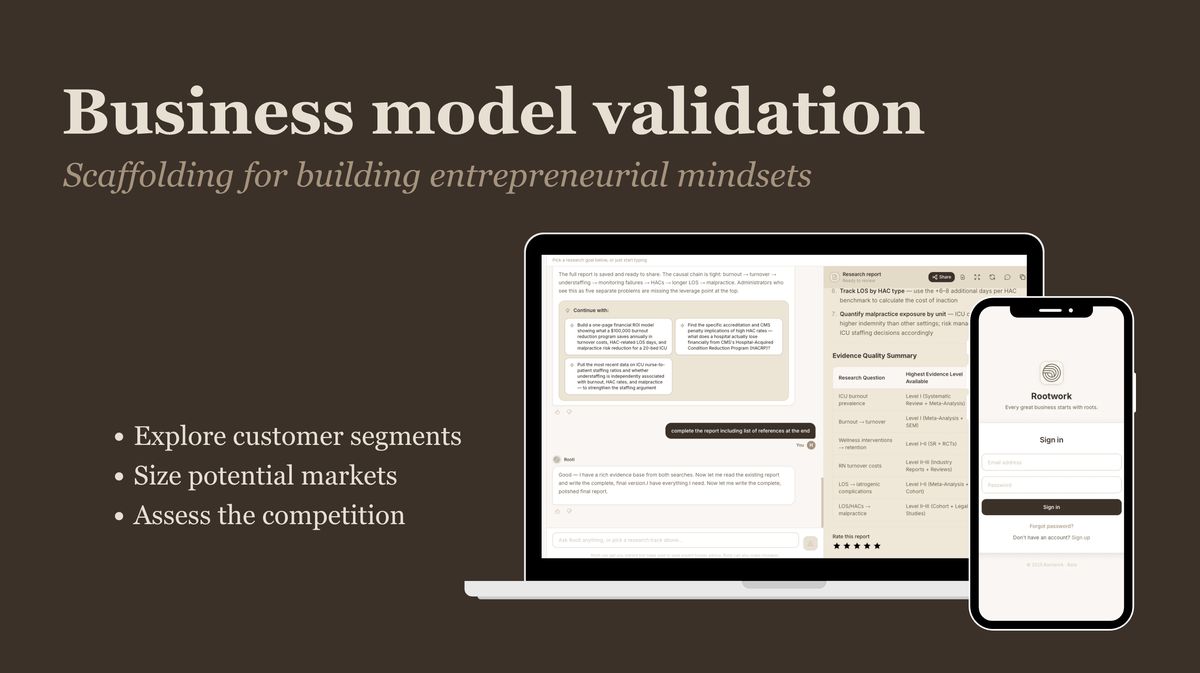
Rootwork scaffolds the process of validating business ideas using data, hones the language of business for novice founders, and prepares them for validation in the real world — the critical conversations that create forward momentum.
Try RootworkFor ecosystem partners
Building the innovation economy is a team sport.
Whether you're a librarian, faculty member, innovation center program manager, or advisor — we'd love to help you bring Rootwork to your community.
We're running a distributed network of pilots with trusted partners to test our claims and build robust evidence for future direction.
Register for an information session
We're holding two information sessions for those interested in running a pilot with their community. Both Zoom sessions cover the same information, so choose the one that works for you. A recording of the presentation portion will be available on request if you aren't able to make it to the live sessions.
-
Register for the October 22 information session
Thursday, October 22, 2026
2:00 PM CT / 3:00 PM ET · 45 minutes
-
Register for the October 29 information session
Thursday, October 29, 2026
9:00 AM CT / 10:00 AM ET · 45 minutes
Can't make either session? Email info@dataweb.ai and we'll send the recording.
How it works
-
Get in touch
Register your interest using our short Google Form, or join an information session.
-
On-boarding
We'll send you a scheduling link for a brief online onboarding session, connecting face to face to share materials, a unique access code, and your evidence dashboard.
-
Share back
We'll convene pilot partners online to share what we're learning across the network.